Wednesday, August 3, 2022

Proofreading, copy editing, and developmental editing: What they are and when to have them done

When it comes to making your written piece of art — whether it be your novel, screenplay, business proposal, or even your Christmas newsletter — the best that it can be, it sometimes takes a village, as they say. You can't necessarily do it all alone. Bringing the written word to life does not happen in a vacuum, no matter what myth or legend you may hear about famous authors hiding away in a cabin the woods for months to produce their magnum opus. Somewhere along the line someone outside of yourself needs to read the thing and find the mistakes in the thing so that you can make it better. 

Sometimes, if you put the piece away for a while before looking at it again, you can do the bulk of this yourself. In fact, writers are known to go through several versions of a novel or screenplay or book before they consider it is "done." And even then, there may be more to do. And there are people, like me, who can help writers to the point where the piece is finally completed.

Typically, there are at least three different types of passes through a piece of written work or manuscript before it is published (or submitted or mailed out, etc.): the developmental edit, the copy edit, and the proofreading pass. 

The Developmental Edit

In writing and rewriting the various versions of their work, a writer may want someone with an objective eye to go through their work-in-progress (WIP) to make sure the plot, characters, flow, structure and form of their piece. Again, sometimes a writer can do this themselves by putting the WIP aside for a few months and then taking another look at it. But sometimes, it's better to hire someone else to do this. This is not proofreading or copy editing, though there may be some proofreading involved, since the editor will probably point out various errors they find. 

However, at this point, the editor and writer should have a conversation about the WIP and where the writer wants to see it go, what s/he is trying to accomplish with it, etc. Chances are, the writer has been living and breathing this WIP for months or even years, so that they can't see it objectively anymore. The editor, however, is coming to the piece with fresh eyes. As the editor and writer are about to become a team, the writer needs to let the editor in on what is supposed to be going on in the WIP. The editor then takes the notes from that discussion and reads through the WIP to see if the work accomplishes what the writer is working toward. 

Using a novel as an example, during the developmental edit, the editor pinpoints where the story works and where it doesn't work. They look at structure, plot holes, character strengths and weaknesses, and they may have ideas and make suggestions on where to make changes to a WIP. If the WIP is a Master's or Doctorate thesis, the editor will look at whether the argument works, is the logic sound, are the sources used strong enough to hold up the argument. Same if the WIP is a business proposal. The editor can't just be plucked from the ether. It is very important for the writer to find an editor who knows and understands their field of study or genre or area of expertise. Again, the editor and writer become a team at this point. The editor is helping the writer make the WIP stronger.

The developmental edit is a longish process and there may be much back and forth between the writer and editor after the writer gets the notes back from the editor. Again, the editor and writer are working as a team. 

The editor may quote a per hour charge with an estimate for the number of hours or a flat rate, but it will not be inexpensive or overnight. The manuscript may be in the editor's hands for at least three weeks to a month, maybe longer, depending on the manuscript. And again, it's not inexpensive. This is not something that you can just post on a job board and get done for $100. 

After the WIP is finished, it is ready for publication, right? No. Not quite yet. After the writer gets their manuscript back from the editor then they need to go through and make the changes that they have decided on (this is the writer's piece, they don't have to do what the editor suggests, they are suggestions). And this may spur the writer on to make at least one more set of revisions, or more, depending on the suggested changes. It's a process.

The Copy Edit

Next up is the copy edit. The writer has gotten the manuscript, whatever it is, into as close to "done" as they possibly can. Again. And now it's time for a copy editor to whip it into shape. 

A copy editor makes sure the copy itself (not the structure or plot or characters) is as good as it can get. They look for awkward sentences, the flow of words, as well as grammatical mistakes, typos, and missed or wrong words. They might check for too many long sentences or see too many short sentences, or too many ungrammatical sentences. They check for "word stacks" (when words line up oddly on a page), or if words are repeated too often and can make suggestions for synonyms in those instances. They also can do fact checking, number checking (for data and tables or phone numbers and addresses), whether a name is spelled consistently throughout a piece, or check to see of you meant Kansas City, Kansas or Kansas City, Missouri. They do a lot of nit picking on the writer's WIP. The copy editor is like the TA for your English Composition class. They don't care about your big ideas, they just want to make sure you said it well.

A copy editor also ensures that the manuscript is formatted correctly. Most people don't pay attention to format or style guidelines, but manuscripts, depending on what type they are, need to adhere to certain formatting rules and style guidelines. Most newspapers, for example, follow AP guidelines. A doctoral thesis for a Ph.D. candidate in the social sciences will need to make sure they follow APA guidelines. A Master's candidate in the fine arts will need to make sure their thesis project follows MLA style guidelines and formatting. Most books and novels follow Chicago style guidelines and formatting. Screenplays have very strict formatting guidelines, and their own programs for adhering to those guidelines, which are different from stage play scripts. 

The writer and copy editor have to discuss what rules the manuscript needs to adhere to so that the copy editor can make sure there is consistency throughout the WIP. For example, in AP, you spell out numbers one through nine and then write them as numerals beginning with 10. Chicago style, however, has you spell out numbers up to a hundred, and then write them as numerals after that. Different publishing houses and publications might have variations on that. It helps if the copy editor is knowledgeable in not just the genre/type of manuscript, but also the guidelines and formatting that need to be used.

The copy edit can also take some time to accomplish. Maybe not as long as the developmental edit, but it is a detailed process. Don't be surprised if a copy editor asks to have your manuscript for a couple of weeks, or longer. They could get it done more quickly, possibly, but then they might miss something. You don't want them to miss anything.  

So, finally, your magnum opus is done, right? You've made the changes the copy editor outlined, double-checked spellings and facts and it's perfect! Right? RIGHT?!

No. Because after you have made all those changes and can't see straight anymore, chances are you made fresh mistakes, or you (or the editor or the copy editor) have missed something. So, now it's time for the proofreading pass. It's the last chance to catch everything.

The Proofreading Pass

There are so many job boards I have seen lately that paste the proofreading label onto a job that includes everything from answering the phone to editing to data entry. Writers often make this same mistake, confusing what they need (a developmental or copy edit) with what proofreading is. There are some writers who have sent me their manuscript asking for a proofread and it's just their first draft. What they want is a developmental edit, and they should be on at least their third draft before they even try to find an editor for that.

There is no point in paying for a proofreading pass until you have your manuscript absolutely ready for submission. The proofreading pass is the final read through by someone other than the author to catch any misspellings, wrong words, mistakes, holes, dropped sentences, weird formatting mistakes, etc. The proofreader's job is to go through with a fine tooth comb and find all the leftover names that didn't get changed for example, or make sure that there aren't any half sentences that happened when the writer was making changes. 

This isn't something one asks for overnight, either, although it shouldn't take too long, depending on the proofreader's schedule.

So, again, finally, after the proofreading pass, the writer can go through and make what corrections they choose to make (again, this is the writer's WIP, so after the editor/copy editor/proofreader have pointed out mistakes and possible problems, it is the writer's responsibility to make those changes, or not, as they see fit). And then, the manuscript is ready to be submitted for publication.

But then, if, for example, the writer has submitted their work to a traditional publisher, the whole process may happen again, because publishing houses have their own style guidelines and editors.

Writing is a process. Bringing a WIP to the point where the rest of the world can read it can be a much longer process. So, don't hurry it. If you have WIP that needs an objective eye, take your time in choosing the right person for the job.

Monday, August 1, 2022

Reading vs. Audiobooks

First off, welcome back! It's been awhile. Well, it's been five years since my last post. My Wordpress Blogetary blog kept getting bombarded and attacked by viruses, etc. So, I took it down. Then, Teddy died. I adopted two new kittens, and after a while, the pandemic happened, and I just plain forgot about this dear old Blogger blog that I had set up years ago. 

Today, I was going through job posts, looking over my Etsy shop wondering what I could do to sell items, or even sell books, or get more freelance work or SOMETHING. And I realized that back in 2008 when I was in this situation, I had a blog (Blogetary, of course) where I posted book reviews, opinions on proofreading, and all sorts of other ideas as a way to get myself "out there." So, while blogs are considered "old school" these days, there are people who still happen by them occasionally. I decided to pull this particular blog out of storage, dust it off, and see what I could do with it. I've renamed it Putt Putt Productions, the name of my freelance business. Slow and steady wins the race is my motto, cuz you have to keep going, even if slowly, if you're going to get anywhere. So, here we are. 

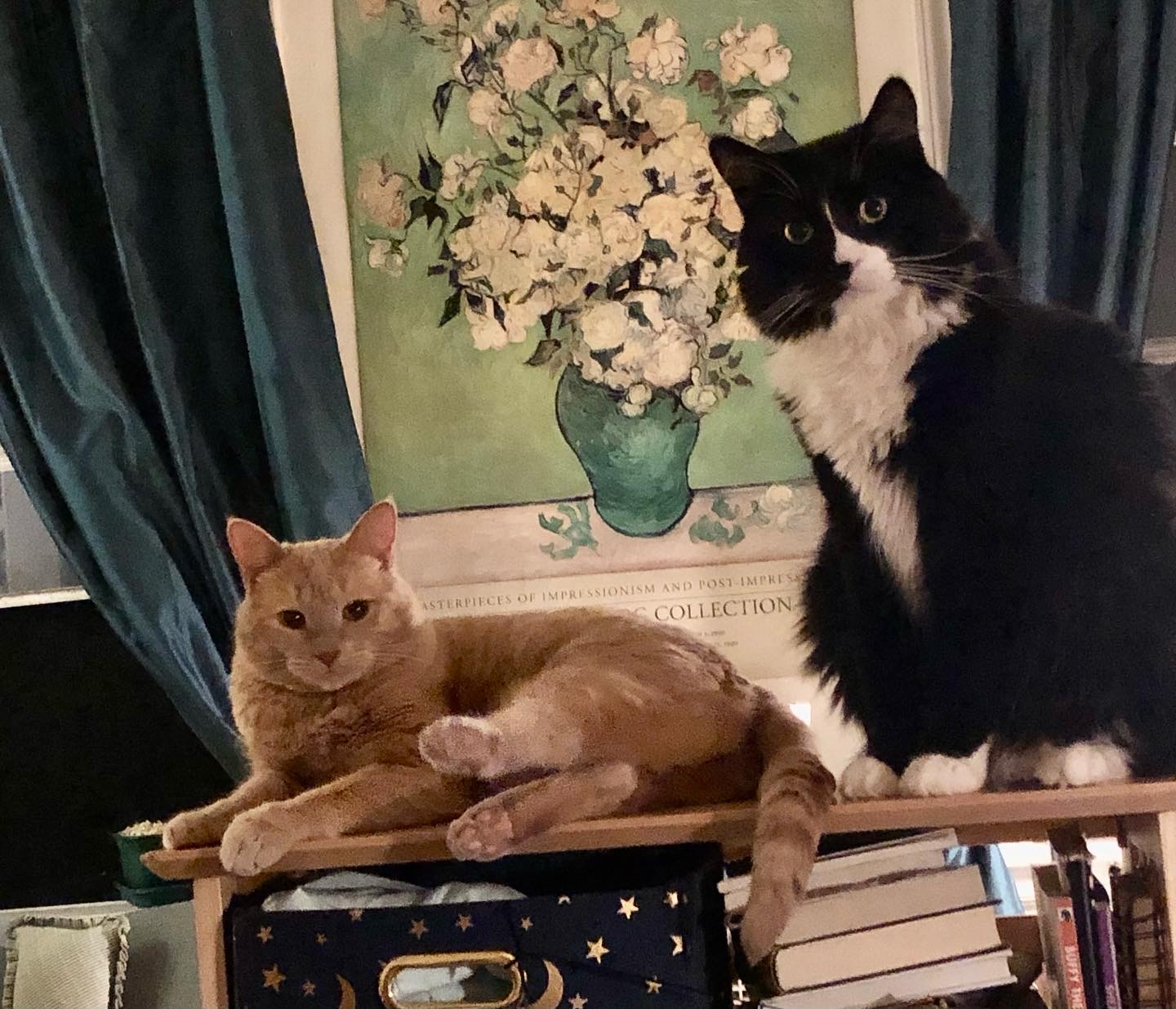
Below is my "cat tax," as friends call it, or photos of the two felines currently in residence at Chez Olivier as a bribe for reading this post. Here are Pippin and Dakota. Thank you for reading thus far, and read on for the current events at Putt Putt Productions.

Today, I'm going to discuss reading vs. audiobooks. 

For most of my life, I have not been a fan of audiobooks. It just wasn't my thing.

Now, I have a whole passel of friends who, at this point, would jump up and try to tell me about all the different pod casts out there that they just LOVE to listen to. And I would nod and smile and make note of the programs and promptly forget the names of them. Or listen to one program and not get into it and promptly forget about it again. And when articles come online that are video vs. written, I'm the one who would rather read the article than watch the video. The video just annoys me, while I can skim the article to get to the meat of what I want to find out. One friend of mine has pointed out to me in the past that I'm a visual person at heart. I need to see the thing. Read the thing. For it to get into my brainpan.

Now, I have always liked listening to the radio, music, and sometimes radio programs, too, or stories, but especially NPR or public radio programs. The public radio programs made me feel smart, to know what was going on. But, I quit somewhere along the line for two reasons. One was that I realized that the programs and reporters all had the same cadences and sound cues when discussing or introducing a topic, which irritated me. I wanted someone to do something different. Why did it always need to be the same? (Okay, now that I've worked for a newspaper I get that it's a "style" thing. But note, that I no longer work for that newspaper anymore because one of the things that drove me nuts was that we could never be different. If you know me, you know how much that irks me.) The second reason (going back to the radio programs) that I quit listening, was that they were all getting too damn depressing. Waking up to hearing about droughts, wars, famines, and presidents who don't care about the common person just wasn't my idea of a way to start the day.

Anyway, during the pandemic, EVERYTHING was too depressing. It didn't matter if you were listening to it or watching it or reading it, it was all bad. (To be honest, it's still pretty bad if you're paying attention. We've just adjusted our norm.) Like everyone else, I was bingeing on lots of streaming movies and TV to keep the world at bay. I quit writing creatively. And for some reason I wasn't able to concentrate my eyes on a page for very long to read a story. I had to read for work, of course, but even that became hard to do, so it's no wonder that reading for pleasure somehow dropped off the radar as well. And that's when I decided to look into audiobooks. I wanted something that I could do, that my brain could hang onto, while I did something else useful, like dishes, or crochet. I didn't want to just sit in front of a screen all day. I wanted to do something, but I wanted to be accompanied by stories. 

Stories are my brain food. While some people like learning by reading articles or hearing lectures. I like learning through stories. The lectures and articles are fine, and not saying I don't dabble, occasionally. And when I was a kid there were some biographies that I read repeatedly, but they were written for kids and some aspects were probably fictionalized.

I have a brain made for fiction. That's just the way it is.

Storytelling, fiction, is like the coal or the steam or the battery or the gas that keeps me going. I need that, but watching TV and movies or sitting and reading a book all day doesn't get the laundry done. So, in short (too late!) I turned to audiobooks to get my storytelling fix while trying to be productive.

I began with books I had already read as a way of dipping my toe in, and then checked them out via Libby, which is your local public library's way of handling electronic media. 

Audiobooks are usually spendy. The publishing company has hired a producer and narrator/actor and has bought or rented equipment to bring this audiobook to the public. So, that makes sense. But, using your local library, they're free!

I feel like I fell in love with the written word, or storytelling, all over again. I've learned a lot in exploring both books I have already read and those I haven't. Some of the books, the Narnia books, for example, were each read by different famous British actors (the Brits know how to do verbal storytelling). Other books are read by the author, which I always like. Neil Gaiman is the best at this. He knows how to read a good story. Some of the audiobooks available are actual radio presentations that were on BBC radio. And there are some narrators out there that are famous in the audiobook world and are the introducers, or presenters, if you will, for the narrators of new works. George Guidall, who narrates "The Cat Who" books is one of these. He's got a fantastic reading voice. Sometimes book series, such as the Harry Dresden series by Jim Butcher or the Maisie Dobbs series by Jacqueline Winspear, or the Sherlock Holmes Bookshop series by Vicki Delany, will have changed out their regular narrator for another one, for various reasons.

Something to remember about storytelling is that it was originally the bard's art, an oral art. Telling fables, myths, family legends, etc., was something that everyone participated in at night after dinner or supper or what-have-you, around the fire. This was how history was originally passed down over the ages, and why our current TV pastime is still so popular. Our inner selves remember the times when we gathered around the hearth to hear tales of daring do. We just happen to have those oral tales now accompanied by moving pictures.

A large part of the enjoyment of audiobooks has to do with the narrator (those of you who are bards would nod in concurrence). If the narrator is bad, the enjoyment is greatly diminished. And I admit that there are some average books that I gave up on when the narrator was bad. There was a book narrated by a famous actress that I just couldn't finish. And when I noticed she had narrated some other favorite books, I knew to skip those particular books and saw with relief that there were other versions that had been read by a different narrator that I listened to instead. It doesn't matter if someone is a famous actor, they're not always the best storyteller or reader. James Marsden, who narrates the Harry Dresden files, is fantastic. But sometimes, you I can't get past the cadence or the mispronunciation or whatever it is that is annoying. I mean, you can adjust the speed on audiobooks and I think that helps sometimes, if you're going through an annoying bit. I was reading an early JP Beaumont (by JA Jance) the other day, written in the 80s, and while the narrator was great, the story was really annoying me. Way too curmudgeonly, old-guy-gets-the-pretty-girl, ugh! But I had good memories from the series (way back when, it was the first time I read a book where Seattle was the background character when I was younger) and I wanted to know how the mystery got solved. So I played about half of it on 2x the speed to get through the bits that annoyed me to get to the end. The equivalent of skimming the pages.

But the narrator has to be someone who can voice different characters as well as read a good tale. They have to be multi-talented. With the Winspear/Maisie Dobbs books, for example, the narrator (there were two, they changed after third or fourth book, I think) needed to be able to do all the various English accents, from upper class to working class, as well as American, Canadian, German, and French accents and languages. Recently, I was listening to My Life in France, by Julia Child and Alex Prud'homme. That narrator, Kimberly Farr, had to read lists and lists of foods and some conversations in French. That was fantastic.

And sometimes books just don't translate as well into audiobooks as you would want them to. Cosmicomics by Italo Calvino is one of my favorite books. While I enjoyed the audiobook, it just didn't resonate with me the same as when I had read it. In the Discworld series by Terry Pratchett there are also some books that don't necessarily translate as well. There's almost too much going on in the story for it to work in an oral landscape.

It's interesting though, how listening to a story is different to reading a story. Reading a story is very internal. You're processing the words visually while imagining the voices and pronunciations and the scenes. Listening can also be internal, I mean, if you're using earphones in the office, for example. But it's more external in nature. Someone else is providing you with the soundtrack of the story. You're no longer making it up on your own. You have to process things differently, too, at least I do. When action scenes happen, for instance. Sometimes I have to rewind the story a few times to get what's happening, where if I were reading it, I'd just soak it all in, like osmosis. 

Currently, I'm listening to Wonder Woman: Warbringer by Leigh Bardugo. I read it a few years ago and always hoped it would be part of a series of more Wonder Woman stories, maybe by different authors. Ah, well.

It's been fun listening to it, almost like another Wonder Woman movie, but not. The narrator, Mozhan Marno, has a good handle on the characters and brings the story to life.

I haven't given up on reading in the normal way. Not at all. But I have learned a lot about the processing of words and stories in my exploration of audiobooks. I've really enjoyed it as another way — perhaps the original way? — of enjoying my stories.

If you haven't gotten into audiobooks, I suggest you try it out. You can access them free via your local library. And unlike TV,  you don't need a screen. Just download the app on your phone and find a good book to listen to while washing the dishes or gardening or doing the mind-numbing work at your desk that you don't want to do, or whatever it is you're doing in the course of your day.


Monday, January 30, 2017

Waging Peace

AFTER I RAN out of blank cards, I started decorating regular Christmas cards.
(Crossposted from Blogetary 2.0.)

The need, the drive, didn't hit me immediately. It came on me slowly, sneaking up on me from the side, in a zigzag pattern like spies or commandos storming a building in a World War II movie.

But first, after the initial shock and bottoming out of my stomach on November 8, 2016, my emotions went all fire-engine red and boiling hot orange anger mixed with gray despondence and despair. I couldn't believe half the country had decided not to show up at the polls so that 25% of the country could vote in a man who makes fun of the disabled and thinks it's okay, normal even, to speak with such disrespect about women or immigrants or anyone really, other than himself. It had been a year since Dad had died and I felt like I was grieving for my dad all over again, AND the country he'd immigrated to, at the same time.

But eventually, I needed something — anything — to keep me going, get me past this and back to life. Staring off into space for hours at a time between bouts of rage and grief does not pay rent or get stories written or feed the cat.

Normally, writing is one of those tools I use to find my way around my emotions, but I was too raw to write. It just seemed to make things worse. I just got angrier, especially at anyone who called for acceptance and calm. All those people asking for that felt too much like the slimy arm of some creepy authority figure trying to manipulate me into behaving a certain way. It felt wrong.

At the same time, the anger wasn't productive, but it wasn't going away either. I still needed to figure out how to manage all this anger and grief. Teddy, my cat, tried to console me. My heart was breaking for dreams I had held fast and hoped would come to fruition since I was a little girl. These were dreams I'd had for even longer than I'd wanted to be a writer. Dreams of hope and a world where everyone had a place at the table, no matter their gender, race, religion, ethnicity. These dreams predated my desire to write stories.

TEDDY DID his best to console me while I worked through things.
So, I had no words to describe what I was feeling; no words for dealing with the grief. Anger, hurt, and betrayal cycled through me constantly. I tried to tamp them down, but always I was wondering, did those people who voted for Trump, some of them quite possibly friends and family, did they truly comprehend all the damage he would do? That people they knew and loved would lose access to healthcare? Did they care about that at all? Did they care at all about the people they knew in blended families — blended genders, blended nationalities, blended religions, blended sexualities? Did they care that free clinics and Planned Parenthood clinics and other programs who help people with little or no access to healthcare probably kept people they knew healthy enough to be productive members of society? Did they care at all about all those people, from babies up to adults, who are disabled and probably going to lose access to necessary education and occupational programs? Did they not get that science is real and climate change really is killing us all?

Or were they as angry as I was, but from a different viewpoint altogether? Were they so clouded with fear and anger at losing grasp in a changing world that their vote was a last attempt to hold onto a world that no longer existed? Maybe they truly believed that the world was a zero sum problem, so if someone gets more, they automatically get less. Maybe they didn't realize that if we all win together it's better for all of us. Maybe they didn't grasp that just because people with different beliefs were showing up and asking to be counted, didn't mean any one belief system or way of life was being invalidated.

I kept wondering why they didn't understand: If they didn't believe in a woman's choice to do with her body what she will, or that people of the same gender could marry, or that other religions were just as valid as their own, or that science was real and we all deserve to have access to, or the ability to obtain food, clothing, shelter — that that was their choice. They could believe that if they wanted. If they wanted to keep their world small, that was their choice. But that was the thing. It was their CHOICE. The rest of us chose NOT to live in that small world. And we continue to choose NOT to be sucked into that dark abyss with them.

As angry as I was with that particular "them" — the "them" who had chosen a smaller, darker world — I also knew that somehow I needed to get past that anger. Somehow, the world needs to change to allow all of us to co-exist, not just a few of us comfortably and the rest tossed under the bus. And I knew that I needed to actively participate within myself for that change to take hold.

Of course, I wasn't thinking nearly as coherent as above when I started making Christmas cards and watching Star Trek and Christmas movies. But, my brain couldn't deal with it all, it was too much. No editing or writing jobs were going to get done while my brain was in this fog of grief and disbelief. No reaching out to others on the other side to show them that the world needed to be open and not closed was going to happen while I was just so very angry. In fact, no real thinking was happening at all, at first. It was Christmas movies cuz... Christmas. And Star Trek (TOS, TNG, Deep Space Nine, Voyager ... it didn't matter) cuz Star Trek is always relevant. And then I reached past the words to something deeper and began to create.

I got out my pens, pencils, brushes, paint, glitter, glue, blank cards, old cards, scissors and everything and set about painting and drawing and cutting and gluing and spreading glitter over everything.

At first I was just going to make about ten cards, just enough for some family and close friends. But then I realized there were a few more people to send to, and then I needed to get more laminate pouches, and then more glitter. Eventually, I found that once I got started, I couldn't stop. So I just got as many 4 x 6 cards and laminate pouches as I could afford, ordered more stamps, and set about nonverbally expressing myself as hard and as loud as I could.

I wasn't sure who would get what card at first. I just looked at pictures and colors and let my emotions and creative urges have their way with me. I'd make a bunch of cards, set them aside to "set" and make more, or work on making my Christmas crossword and newsletter. Then, I'd take the cards that were "set" and look through them, and look through my address list and see what spoke to me. The cards told me where they wanted to go.

It was all instinctive. There was no coherent thought to it. Pick up a blank card, think of the colors, look at the bits of paper I wanted to use in a collage, glue, paint, cover with glitter. Let dry. Repeat.
I couldn't stop, so I decided to go with it. Each night I'd do as many cards as I could, wearing myself out so I wouldn't cry myself to sleep.

Once I got through all the 4 x 6 cards I had purchased, I found regular Christmas cards and started decorating them, too. Colors and glitter. If I was being forced to have a president who believed in a dark world with no color, then I was going to make sure I spread the color and the glitter and light and life as far and as wide as I could. I don't even know if I can describe the fierceness in my heart at how necessary it felt for me to do this.

It was early/mid December when I finally felt myself floating to the surface of my emotional ocean. Coherent words and thoughts were finally stringing themselves together outside of work. And the phrase that kept repeating itself in my head as I worked on my cards was "waging peace." And that's when I realized that what I had been doing was fighting a war in my heart to match the war "out there;" I was waging peace.

And then it was like everything broke loose. It didn't matter if you were anti-Trump or had voted for the orange monster, or someone else, I was waging peace with these cards, and I was waging it in your direction. And dammit, I was going to be heard. This was my effort to reach out and get my message across — not with words, as words had failed me. If you weren't going to listen to me or any words I said or wrote before the election, you weren't going to care about any words I said to you now.

But now I was waging peace with color, pictures, paint, glitter, and my purely emotional and whimsical hope for a holiday that would be merry despite the despair in my heart and the fear and hatred peppering the world.

And I believe this still. Somehow we all have to get that message out there, past the prejudice of speech and old arguments, go primal and pre-speech, with hearts and dreams and color and glitter and hope — we have to reach out to the world and wage peace.

Wednesday, December 21, 2016

Christmas Crossword 2016

Crossposted from Blogetary 2.0.

The last few years I've created my own little tradition of creating a Christmas crossword puzzle for my Christmas newsletter. It's no New York Times-level crossword, but it's fun to create and share. After I make sure everyone's had a chance to see it in my newsletter, I like to share it out in the great wide world, in case there's someone else out there who might have fun with it. So, now, without further ado, this year's Christmas crossword.

Saturday, October 1, 2016

Editing: Getting From There to Here

Proofreader, Copyeditor, Editor
(Crossposted from Blogetary 2.0.)

When Putt Putt Productions was first begun, I used to have "Writer, Proofreader, Copyeditor, Editor" on my business cards. I had experience with very detailed bookkeeping type work and had proofread for the periodical librarians back in college. In addition, at the time I filed the DBA for PPP, I'd been working for a company where I was speed proofing and formatting several documents a day (think double digits), sometimes having to change which style rules I was supposed to adhere to (APA, MLA, Harvard, Turabian..., or some variance in between) from one document to another, and also making sure everything was up to snuff with our own style/formatting code. And then sending the documents on to the clients after they were approved by the editors and my bosses.

Somewhere along the line, between proofreading the documents and passing along client order requests to our editors, and troubleshooting or passing along information from client to writer and back again, and generally running the office when my bosses and other editors were off doing other things, I began taking those orders myself, assigning writers, making decisions about content, sending along documents, and then advising my bosses and editors after the fact of what had been done. One editor I worked with pointed out I was, in effect, an assistant editor at that point.

Because of the extent to which I did all that work, and the freelance writing I did for this company after hours, I had no problem putting "Writer, Proofreader, Copyeditor, Editor" on my business cards.
But then something happened in cyberspace. I interacted with people, writers and editors, in the small speculative fiction community. I wasn't diplomatic about something and didn't behave well, and someone wrote that if I were a "real" editor, I would have known better. Paid better attention, understood the responsibility, etc.

After considering what I did and what they said, I realized they had a point. I took that bit, "editor," off my business cards and have assiduously avoided being called an editor ever since. I wanted to be honest about what I could do for people. Some people use the term "edit" loosely and things can get messy when that happens, especially when we're talking about paying for the service. I had experience with academic research documents, but relatively little in fiction or newspaper or magazine copy. I knew I would gain more experience in those areas, but until then, I didn't want to promise more than I could deliver.

Well, that was back between 2000 and 2005. New Year's Day this year, 2016, a friend of mine approached me about being a developmental editor for her piece of fiction, a novel-length work.
I had done some proofreading and copyediting work for her. I had helped her spruce up copy for letters she was sending, but editing — developmental editing — a full piece of fiction for her, I wasn't sure I could do it. Even after over a decade of beta reading, proofreading, copyediting on stories, marketing documents, dissertations, theses, articles, and even at the paper, I still felt like a fraud in saying yes to her. However, she talked me into it.

This afternoon, I looked up from going through her book for the third time and realized that I was doing it. I felt like a kid learning to ride a bike who suddenly realizes her mom let go of the back end halfway down the block.

WHOOOSH!

I'd been editing!

Time to put it back on the business cards...

Wednesday, September 21, 2016

The Epistolary: Writing Exercise and Personal Journey

Crossposted from Blogetary 2.0.

Back in July, I was going through a book of writing exercises and the one I was working on was called an epistolary. You pretend you come upon a stash of letters, or even use a real stash of letters, and write story from that, basically reconstruct the letters into a story.

Such an exercise is actually one of the earliest versions of the novel, or so my professors taught me when I was at Western. Fanny Burney’s novel, Evelina, was one such novel. Carrie Fisher wrote her semi-autobiographical novel, Postcards from the Edge, using an epistolary form for the first part of the book, leading the reader from postcards and letters to journal entries, before finally landing them in the first person narrative of the story.

Well, I thought I would take a stab at it, though it was probably going to take longer than a single night. But I got caught up in creating this thing, and ended up working on it most of that evening before finally winding up to the ending that had been in my head since the beginning of the story.
I feel good about that story, what I did and where I took it. The style reminds me a little of one of my favorite writers, Italo Calvino. I hope I haven’t inadvertently copied him. I’ll have to look into that. I’ve gone through the piece once, but it’s still “baking” (Rising? Proofing?) right now before I go through it and do some more tinkering. It’s been a few years since I sent anything out there. Not even sure where I’d send it! But I shouldn’t get ahead of myself. It needs a few more drafts before I even think about that.

In the middle of writing that piece, I also realized I had material ready-made for a real epistolary. I had letters and cards I had sent to my dad from the time I was in grade school on up through college.

But let me back up a bit so you get where I’m coming from.

As my friends and I get older, more and more of us are becoming members of the “adult orphan” club. Some people “lose” their parents at a young age (though I hate that term “lose” – as if a person were an earring or a set of keys) and that is a devastating experience I’m thankful I never went through. The rest of us who are lucky enough to have our parents around into our adult lives, usually don’t have to worry about becoming members of the “adult orphan” club until we reach at least our 40s and 50s.

And then we watch and wait as each of us in our cohort becomes a member of the club. Whether suddenly, or as a result of a long illness, eventually our parents die. And even though we are adults, that experience of “losing a parent” crushes the child within all of us. I remember years ago talking with a neighbor about it. She was in her 60s and she talked about how much like an orphan she felt after her mother died some years before. Another friend of mine whose parents had both passed away a few years ago has said it was like losing his champions.

Neither of these people had perfect relationships with their parents. And yet, they still felt overcome with loss when their parents died.

And when that happens, when a parent, or anyone close like that dies, those left behind are left with putting the rest of those lives, the personal belongings that had meaning once upon a time, to rest. Because it’s not over when someone dies. I mean, some people are more prepared, more organized, than others. My grampa had a list with all the information needed for accounts, who to call and notify, the stuff about the will, what to do with his body, etc. Most people aren't that prepared. Even with all that, it still took time.

After the body and brain have ceased to work and have been cremated or laid to rest or otherwise taken care of, it can take months, or even years, for a person’s entire life to be put to rest.

After all the relatives, friends, agencies, acquaintances and everyone else has finally been notified of your loved one’s passing, after the body has been disposed of, after you have acknowledged your own grief, there’s still all the material possessions to go through, homes to figure out, the online life to slowly shut down, the financial threads to be untangled and released. Jumping through hoops with people over the phone or in person who are trained NOT to believe you when you say, “I’m trying to shut down the email/account because my father/mother/spouse died and no, I do not have the PIN, but I might have the password and I do have the death certificate/social security number….” Or whatever else it will take for them to believe you.

And as much as you think it will be something you will have cleared up maybe a month after the death, that’s just not how the world works. Your body holds your grief as pain, and every task you do in laying your loved one to rest is taxing your body, your brain, your emotions. It is all painful. If you can accomplish one task a week while continuing to carry on with your life, that’s doing okay. If you can do one task a day? Phew! Wow! Make sure to give yourself time to crash and burn, because your body will demand it; laying a loved one to rest is hard work.

After watching other friends of mine who have had to go through this, and now as my family goes through a “laying to rest” of my father’s life, I think a safe guess for how long this takes is 18 months. Yes, after a parent dies it could take 18 months before everything with their lives is finally settled and laid to rest. Maybe more, maybe less.

But when this happens to you, and it will, remember that. Mark it on your calendar and hold it out as a marker to hang onto when it seems like everything is taking so long to sort through and manage: 18 months.

Earlier this year, in the spring (about six months after Dad died), one of the projects I took on to help lay my father’s life to rest was to go through the personal correspondence he had kept over the years and, if possible, mail it back to the people who had written him.

At first I just picked at the pile of correspondence that spilled out of the package. I figured it would be an easy evening in front of the TV. You know, just tossing the cards and letters in piles whilst watching Star Trek or Grimm or something. Right? I might cry, but that would be par for the course.
But it was more difficult than that. I couldn’t seem to approach it head on. I pulled out some folders I could use for keeping them organized. I’d pick a card or letter up, see who had written it and put it in a pile, but then pull another one out and the first one would tumble somewhere and get lost in the pile again as I read the second letter.

And then one day, I just started in. Not just sorting them, but reading them, thinking about these people who loved my father and wrote him, remember the stories he’d told me about these people he loved back.

My dad wasn’t sentimental, most of the time. He was English, which is not quite the same as Nordic, but bordering on it (Viking genes, you know). But he wouldn’t have kept these letters and cards if the people who wrote them hadn’t meant something to him.

I know. I was reading private correspondence, and a part of me felt squeamish at that. But the writer in me was fascinated at the breadth of story that could be mined in this correspondence. The daughter in me, who missed her father so much, just wanted to hang onto one more thing that was part of her daddy.

I could only do a few each night. The more I read, the more I remembered about my own life, what Dad had told me about his life, and the more I learned about these people my dad loved, as well as about him. I cried every night thinking about the love in this family. It was exhausting.

For example, there were cards and letters from my Nana and her mother, "Mrs Edwards." Nana, or more formally Grandmother Iris (but we just called her Nana) was my dad’s stepmother. I remembered Dad describing a distant relationship with a woman who may or may not have cared for him. For my sister and I, she was the grandmother in England who would send us the occasional nice gifts for Christmas and had the handwriting that was nothing like Dad’s or Mom’s or Grampa’s and Gramma’s. So, I never really knew her. However, these letters were from a woman who really cared about Dad. She encouraged him, asked about him. And her mother, even, really enjoyed my dad, sending him a card or two as well.

There were also cheerful and newsy letters and cards from his brother and brother’s family. Letters from my sister Heather and I that ranged from one-liners from camp to long, rambling missives about our lives and asking him about his. A couple from Mom. Cards from Meeg. More newsy letters from my sister Elizabeth. And then there were a few letters and postcards from friends who must be long gone now. I couldn’t even decipher the names to figure out a proper place to send them back to; those “orphans” are finding a home with my own cards and letters and the ones from Nana (who passed away a few years ago).
Rambling letter I wrote Dad while I was at college. I was babysitting and we were playing with markers.

Card I sent to Dad for Father's Day, because the antelope was wild and free like my junior high self thought Dad was.

So, back to the idea of epistolaries as a writing exercise.

In July, when I was working on the writing exercise, I was also still sorting through those letters and cards. And after writing the faux epistolary, I had what I thought was this brilliant idea. I thought that after I had sorted through all the cards and letters and sent them off to their homes and only had mine left, that I would do a close read of them and write an epistolary based on my real letters.

I KNOW! Great idea, right?

Well…

Not so much. Or at least, not yet. Well, you can try it if you want to, but I can tell you from experience that trying that less than a year after someone's death is not a good idea.

Beside, real life doesn’t always have a story, an arc, an easy beginning, middle, crisis, and end. And so it was with my letters. There wasn’t an easy arc to follow, no beginning, middle, crisis, and end as I wrote my dad the rambling letters about school and music and sports and boys and moving and jobs. It was messy, like real life.

And that’s the other thing. It was messy, funky, bloody, and too soon, too close to home. The girl that I was, and the woman I have become are completely different and at the same time also exactly the same. But separating out what is story and what is not and how tell a true story out of it all – well…
I have a bumper sticker up in my home office from a publisher as a reminder to be true to the work: “Write Gutsy. Write Lovely. Write Bloody.”
Bumper sticker from Write Bloody Publishing (the founder, Derrick Brown, is also a good poet).

I’d like that to happen sometime with my letters, sticking close to the bone and writing gutsy, writing bloody lovely, but it’s just not going to happen any time soon.

Sunday, September 18, 2016

Breath Stealers: The Monsters Are Real

Crossposted from Blogetary 2.0: http://puttputtproductions.com/blogetary/index.php/2016/09/18/breath-stealers-the-monsters-are-real/

A friend of mine has hired me to edit their novel — developmental editing. It's a deep reading of a piece that's not a simple proofreading or copy editing read through. The editor may read through the work several times looking for consistency, structure, meaning, logic, etc. It can be a long process and requires really thinking about what you're reading. You can't just do it on automatic. Fortunately, my friend wrote a novel that's not only a good story, but also leaves the reader with lots of things to think about.

One of the characters comes to the conclusion, several times, that no matter how hard she tries to do the right thing, the thing that is required of her, it always seems to get her into trouble. She's chopped away bits and pieces of herself over the years to try to fit into what is required by the many factions in her life, and even then, it's not good enough. It's never good enough.

I identified with what that character was going through, so it made me think about that feeling. That feeling that bits and pieces of you have been given away or stolen to accommodate others, and it's never good enough. It's a very familiar feeling for me, as I sure it is for others as well.

When I used to go out dancing, there was a bit of a protocol as to how things were done on the dance floor. Just as in walking on the sidewalk or driving along a street, there are "rules of the road" to allow everyone on the dance floor space to dance, express themselves, and have a good time. There was an assumption that everyone was allowed so much of a "bubble" around themselves. Sometimes you'd bump into someone, or they'd bump into you, but for the most part, most people respected the "bubble," respected the space.

Except for those people. You know who they are. They'd come on the dance floor and it seemed like no matter where you danced, they were there in your space, bumping into you and not apologizing, not moving away, not allowing you your space. So you might move to another part of the dance floor, and there they'd be again. Or you might dance "smaller" so as not to take up all your bubble. This usually meant they just danced "bigger," taking up what you weren't using anymore. You could try dancing "bigger" as they did, but that risked some type of altercation.

So, you might leave the dance floor in a huff to get a drink, only to find that you're now standing next to one of those people, who is pushing you aside to get the bartender's attention before you. If you're lucky, you finally find yourself some space outside in the parking lot having a cigarette, where you can swear at the world, swing your arms and kick the curb, getting the encroacher out of your system.
If you're lucky and they haven't followed you out to bum your cigarette. If you're not so lucky, then there they are again. They took your space and your drink and they literally want to take your breath as well.

I don't go out dancing anymore, but that concept seems to hold true in other parts of my life. There are people out there who don't seem to want to acknowledge that you are allowed your space, your breath. They walk into a room and take up the entire room with their presence. I'm not talking charismatic people who have a large presence, I'm talking about those people who steal the room. They steal your space and everyone else's space in the room. They steal their attention, their voice, their breath.

If you are anything like me (and there are a ton like me, I know), you think, "fine, I'll just manage fine in this little corner." So you move to that corner, thinking that now the person stealing all that space will be mollified. But they're not. That they have 75% and you have 25% is not good enough for our breath stealer.  They want more. So you make your space smaller. You cut away at your space, letting them have 80% while you decide 20% is enough for you, if they'd just leave you alone and let you have it.

If we were talking sharing the bed with the cat, the dog, and your assorted family members, this might be okay, comforting even, but we're not talking about that. We're talking about people who want to steal your space. You give up more and more of your space, more and more of your place at the table and that's still not good enough for them. Your physical, emotional or psychological parts of yourself that you hold space for? They want that. Everything you hold dear to yourself — your ideas, your space, your opinions, your emotions — they want.

Why? I think each breath stealer has his or her own reasons, insecurities. It makes them bigger, more important. Or maybe they're just absolutely clueless about how they are the big monster in the room stealing everyone else's life.
dont-let-de-boo-hag-ride-ya
In Gullah culture, there's a creature called a Boo Hag, a breath stealer. They're like a vampire in that they steal your life, your energy, but by stealing your breath, not your blood. They creep into your home and float above your body and steal your breath as you sleep. When you wake in the morning, you have no energy. Or if that's not enough, they might steal your skin (you can read about it here).

Probably everyone plays the part of the Boo Hag at one time or another in their lives. I mean, if things go the way they're supposed to on any given day, then life is a bit of a give and take, right? You might give of yourself one day and take the next. Like the marketplace, you get paid and go out and spend your money for goods, which pays someone else, who goes out and spends money for goods or services, and so on, etc. You breathe in from someone one day, and breathe back into them the next. And there will be days when, whether or not you're aware of it, you will be the one playing the part of the Boo Hag. You will be selfishly demanding the space, the breath, the opinions, the energy. They are all yours, dammit! People OWE you! Didn't they know that?

Then you get over it. The huge bubble you have selfishly built from other people's space is burst and you are once more a normal person, not a monster. You are once again seeing that, yes, other people deserve their own place at the table, just as you do. They deserve their space, breath, ideas, opinions, etc. This is an exchange.

But some people never "get over it." The always demand more and more space. Nothing and no one is ever good enough for them. They want it all.

I know other women probably deal with this, maybe other minorities do, too. But you're with a group of people and you don't talk much. You know it's safer to just keep quiet. But then you're asked to speak up, so you do. And as soon as you start to speak up as much as the others at the table — not more than, just as much as — you're suddenly labeled the loud mouthed bitch by the breath stealer at the table (usually just one or two, because they won't tolerate others like themselves at the same table). After listening to said Boo Hag talk about their work for hours, you finally talk about what you do or what you're working on or other things in your life, and their eyes glaze over or they decide to interrupt you. "Too much drama" for them to have to listen and pay attention to someone outside of themselves.

I remember sitting at dinner with a couple and they went on and on against immigrants and people with mental health issues, and several other demographics outside themselves. Grand statements that swept millions of people into a corner of "undesirables," without any thought given to any of those people as individuals at all. And this couple employed immigrants and had family members with physical and mental health issues. They had made a good living doing what they liked to do and instead of turning that good outward to help others, they decided they wanted more, and that the only way to get more was to make sure others had less. (At dinner that attitude made itself known by how often they talked across me or others whenever we tried to make a point or state an opinion.) Making a good living wasn't good enough. Living in their space was no longer good enough. Now they had to take that space away from others as well. I used to think of them as friends. Did I change? Did they? Will they ever come back to themselves? Or were they always selfish bastards?

I was watching a film with friends one night and it wasn't the best movie. It wasn't awful, but it wasn't bad. We kept watching. But one of the people there kept heckling it. If you're at home alone watching a movie and heckling it, fine. Besides, you can turn it off, unless you want to see how truly awful it is. But the movie wasn't in the heckler's home, and it wasn't being turned off. And she kept heckling, not just saying how bad it was, but also using an entire demographic of people (in this case middle-aged women) to disparage it. Why? Why use a whole group of people who have done you no wrong to disparage something? It wasn't entertaining. It was rude and selfish and so bigoted against an entire group of people. I'm a middle-aged woman, for crying out loud! I was getting offended, but I did what I do, which is kept quiet, made my space smaller. That's what we're taught to do with rude people, right?

Was that just a bad, selfish moment for her? Should it have been a learning moment for me? Should I have said something? Will she ever see it on her own? Will she ever come back to herself? Or has she permanently morphed into the selfish monster who wants to claim all the space?

It's like bullying. When I was a kid I was bullied. Back then, you just put up with it. When Todd and Tom wanted to chase me home and throw rocks at me, I learned to hide until they left school and make my way home a different way. When Robbie and John called me names, I ignored them. I played on another part of the playground with other kids. I tried to make myself as inoffensive as possible. Ignore it and it will stop. And sometimes that works with bullying. But other times?
Other times they decide that it's no fun when you ignore them, and to run you down with their bicycle is more fun. They want your space. They want to claim the air you breathe.

When I was a kid and that happened, I ran home to my mom and grandparents and they called other kids' parents. "Things were discussed" and a bulk of the bullying stopped. But when you're an adult, you don't have someone to run home to, except maybe your cat. You just have yourself, maybe a trusted friend to talk it over with, to figure out how to deal with it.

So what do you do? Do you keep self-editing pieces of yourself? Stripping things away to become less and less around others who demand more and more? That doesn't seem right. But then, to go back to the dance floor analogy, trying to constantly dance with your elbows out so you don't lose what little space you have is exhausting. That's not right either. To go back to the bullying example, you could try to find another part of the playground to be on, and that will be okay for a while. But these people don't go away.

My go-to strategy has always been to keep politely silent. Nod and smile until I get home where I can lock the door between them and me. I know that at least this space I can call my own, as long as I can pay the rent. In this space I can write my thoughts and think my thoughts and they are wholly my own.

But I can't always shut myself away can I? Maybe that's what we've all ended up doing in some way or another? Maybe that's why some people become shut ins? They just want their space to be theirs without interference from the big, monstrous breath stealers, and that's the only way they can safely keep their space.

I have no ultimate answer for this. The most I can say is 1) that the Breath Stealer Monsters are real. Watch out for them. And 2) I enjoy developmental editing because it leads me on thoughts like this one.